CLAT 2027 Preparation Strategy: A 10 Week Study Plan

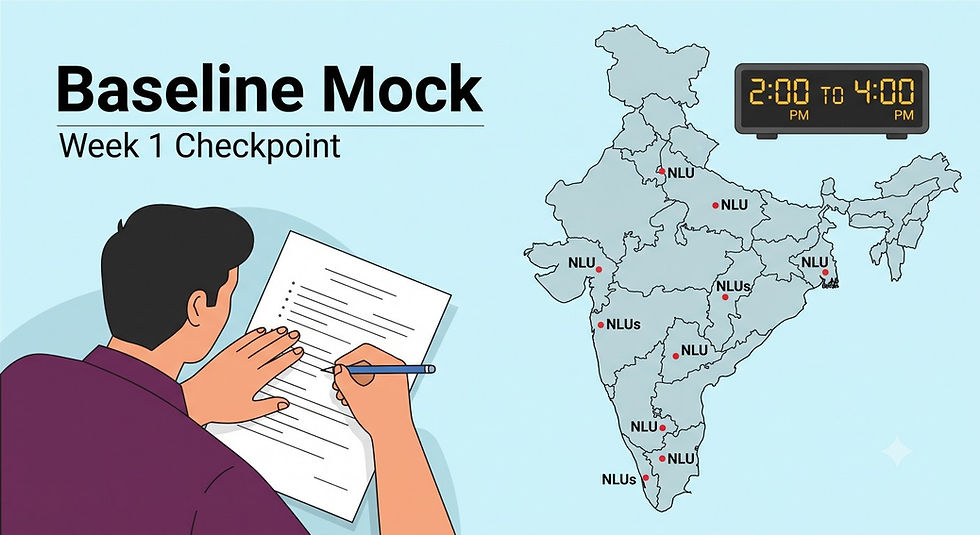
CLAT 2027 is on Sunday, December 6, 2026, from 2:00 PM to 4:00 PM. If you start on Monday, September 28, you get exactly 10 weeks. That is enough time if you can read English passages with ease and practice every day.
The plan has four phases: baseline, skill building, practice, and mocks with revision. Each week has one focus and one checkpoint to pass before you move on.
How to Prepare for CLAT 2027 in 10 Weeks: Quick Answer
Study every day, practice with passages, and let your mock test results decide what you do next. Start with a baseline mock, learn the basics, build speed, and finish with timed mocks.
Phases: Weeks 1 to 2 baseline, 3 to 5 skill building, 6 to 8 practice, 9 to 10 mocks and revision.
Daily hours: 3 to 8, based on your schedule.
Mocks: 8 full-length mocks.
Weakest section: 30 extra minutes daily.
Revision: Review notes and errors every Sunday.
CLAT 2027 Exam Pattern and Marking Scheme at a Glance
CLAT 2027 has 120 multiple-choice questions to solve in 2 hours. The exam is on paper, and every question is based on a reading passage. A right answer earns 1 mark, and a wrong answer loses 0.25 marks.
Section | Questions | Share | Suggested time |
English Language | 22 to 26 | 20% | 25 minutes |
Current Affairs including GK | 28 to 32 | 25% | 25 minutes |
Legal Reasoning | 28 to 32 | 25% | 30 minutes |
Logical Reasoning | 22 to 26 | 20% | 25 minutes |
Quantitative Techniques | 10 to 14 | 10% | 15 minutes |
The paper has no separate time limit for each section, so treat these timings as a guide. Skipped questions score zero. All sections add up to one score out of 120. The pattern has not changed for 2027, but check consortiumofnlus.ac.in for updates.
Take This 5-Minute CLAT 2027 Self-Test Before Week 1
This test checks where you stand today. Answer the 10 questions without a phone or notes, then count your correct answers. Your score tells you which path to follow.
“Candid” means: (a) rude (b) honest (c) shy
Each of the students ___ a book. (a) have (b) has
Which Article guarantees equality before the law? (a) 12 (b) 14 (c) 21
Who appoints the Chief Justice of India? (a) Prime Minister (b) President (c) Parliament
Rule: A contract is valid only if both sides agree freely. Facts: Ravi signs a sale agreement because a man holds a knife to his throat. Is it valid? (a) Yes (b) No
Rule: Careless acts that harm others must be paid for. Facts: A shop leaves a wet floor with no warning sign, and a customer slips. Must the shop pay? (a) Yes (b) No
All lawyers read case files. Meera reads case files. Is Meera certainly a lawyer? (a) Yes (b) No
Find the next number: 2, 6, 12, 20,?
A Rs 400 book gets a 15% discount. What is the new price?
Boys and girls are in the ratio 3:5. There are 40 students. How many are girls?
Answers: 1-b, 2-b, 3-b, 4-b, 5-b, 6-a, 7-b, 8-30, 9-Rs 340, 10-25.
Your path:
0 to 4 correct (Beginner): Add 30 minutes a day to Weeks 1 and 2.
5 to 7 correct (Intermediate): Follow the plan as written.
8 to 10 correct (Repeater): Add one extra mock in Weeks 6 to 8.
CLAT 2027 10-Week Study Plan Overview
CLAT 2027 Preparation Strategy runs from Monday, September 28 to exam day on December 6. Each week has one main focus and a checkpoint. Pass the checkpoint before you move on.
Week | Focus | Checkpoint |
1 | Baseline mock | Score noted |
2 | Core concepts | Notes done |
3 | Legal and Logical | 70% accuracy |
4 | English | 70% accuracy |
5 | Quant and Current Affairs | 70% accuracy |
6 | Sectional tests | 75% accuracy |
7 | Two full mocks | Scores compared with baseline |
8 | Accuracy | 80% on attempted questions |
9 | Three timed mocks | Weak topics revised |
10 | Revision and rest | Ready by December 5 |
Accuracy means the share of your attempted questions that you got right. If you attempt 50 questions and get 35 right, your accuracy is 70%.
Weeks 1 to 2: Build Your CLAT 2027 Baseline
These two weeks show where you stand and teach you the basics. You take one mock, find your weakest section, and learn the core ideas. Finish your application now, because registration closes on October 31, 2026.
Apply at consortiumofnlus.ac.in and choose your test cities.
Save your confirmation page and fee receipt.
Collect recent previous year papers, a Class 10 maths book, and one news source.
Week 1: Take One Mock Test and Find Your Weak Section
Take one full mock in Week 1 to learn your starting score. Sit for the full 2 hours without a break, and check your answers only after you finish. Then find the section where you lost the most marks.
Day 1: Take the mock.
Day 2: Review every wrong and skipped question.
Days 3 to 7: Read 2 passages a day and solve 20 questions from your weakest section.
Week 2: Learn the Core Concepts for Each Section
Week 2 fills the gaps in your basic knowledge. Spend 2 hours a day on concepts and 1 hour on practice. Keep short notes, because you will use them in the last weeks.
Legal: contract, tort (a wrong act that harms someone), crime, and basic constitutional rights.
Logical: premise (a reason given), conclusion (the point being argued), and assumption (something taken as true without proof).
English: main idea, tone, and word meaning.
Quant: Class 10 formulas.
Current Affairs: choose one news source.
Weeks 3 to 5: Build Speed in Each CLAT Section

These weeks turn concepts into speed. You cover two sections a week and time every set. By the end of Week 5, you will have practiced all five sections.
Week 3: Legal Reasoning and Logical Reasoning Practice
This week trains you to read a rule or an argument and answer quickly. Solve 2 legal and 2 logical passages every day with a timer on. Aim for 70% accuracy by Sunday.
Check: Can you finish one passage in about 6 minutes?
Week 4: English Language and Reading Comprehension Practice
Week 4 builds your reading speed and understanding. Read one editorial (a newspaper article that gives an opinion) every day and solve 2 English passages. Aim for 70% accuracy.
Check: Can you state each passage's main idea in one sentence?
Week 5: Quantitative Techniques and Current Affairs Practice
Week 5 covers Quant, the smallest section, and Current Affairs, which needs steady reading. Spend 30 minutes a day on each. Read one monthly news summary every 2 days, starting with the oldest month of the past year.
Check: Can you solve a 5-question Quant set in 7 minutes?
Weeks 6 to 8: Start Sectional Tests and Weekly Mocks

These weeks move you from practice sets to real test conditions. You start with sectional tests, then take full mocks. Every test ends with a review of your mistakes.
Week 6: Take Sectional Tests and Fix Errors
Take one timed sectional test a day from Monday to Friday, one for each section. Review each test the same day and write the reason for every mistake. Use Saturday to redo weak topics, and aim for 75% accuracy.
Week 7: Take Your First Two Full-Length Mocks
Take two full-length mocks this week, from 2:00 PM to 4:00 PM, the same time as the real exam. Review each one the same day using the 30-minute method given later in this guide. Then compare both scores with your Week 1 baseline.
Week 8: Work on Accuracy and Negative Marking
Week 8 is about scoring more from the same number of attempts. Take two mocks and set a skip rule: guess only when you can remove two of the four options, and skip when you cannot remove any. Aim for 80% accuracy on the questions you attempt.
Weeks 9 to 10: CLAT 2027 Final Revision Plan
The last two weeks decide how ready you feel on exam day. Week 9 is for timed mocks and weak topics. Week 10 is for light revision and rest.
Week 9: Take Timed Mocks and Revise Weak Topics
Take three mocks in Week 9, on Monday, Wednesday, and Friday, at 2:00 PM. Use the other days to revise the topics that appear most in your error log. Do not add a fourth mock.
Week 10: Revise Notes and Rest Before Exam Day
Week 10 is for calm revision, not new topics. Spend Monday to Wednesday on your notes, formulas, and error log. Take one short sectional test on Thursday, keep Friday light, and rest on Saturday before the exam on Sunday.
How to Score Well in Each CLAT 2027 Section
Each section rewards a different habit. The weekly plan tells you when to study, and these tips tell you how.
CLAT Legal Reasoning Preparation Tips
Legal Reasoning tests how you apply a rule to facts. Read the rule first, then check each option against that rule alone. Use the rule given in the passage even when real law is different.
After each passage, write one line on why each wrong option fails. This habit builds accuracy faster than solving more passages.
CLAT Current Affairs Preparation for the Last 10 Weeks
Current Affairs and GK cover news and general knowledge. Questions come from passages, so understand events instead of memorizing lists. Focus on the past 12 months.
Court judgments
New laws
Government schemes
International events
Revise Constitution basics too.
CLAT English Section Strategy
English tests reading, not grammar rules. Passages run about 450 words, and questions ask about the main idea, tone, word meaning, and inference (a conclusion drawn from clues in the text). Read the passage first, then the questions, then return to the text to find proof for your answer.
CLAT Logical Reasoning Tips
Logical Reasoning tests how you judge arguments. Find the conclusion first, then its reasons. In "Schools should start later because sleepy students learn less," the first part is the conclusion and the second part is the reason.
Questions ask what follows from the argument, what weakens or strengthens the claim, or what the writer assumes.
CLAT Quantitative Techniques Preparation for Non-Maths Students
Quant uses Class 10 maths in short tables, graphs, or data passages. It has only 10 to 14 questions, so it is the fastest section to improve. Non-maths students can start with ratios, percentages, averages, basic algebra, and area.
Practice 15 minutes daily.
CLAT 2027 Daily Timetable: Pick Your Schedule (interactive)
Pick the schedule that fits your day. All three follow the same 10-week plan, and only the study hours change. Stay on one schedule for two weeks before you change it.
Timetable for Class 12 Students
Class 12 students can study 4 to 5 hours on school days and 7 to 8 hours on Sundays.
Morning, 1 hour: Legal or Logical passages
After school, 2 hours: the week's main section
Evening, 1 hour: news and Quant
Night, 30 minutes: error log
Timetable for Droppers and Repeaters
Droppers and repeaters can study 7 to 8 hours a day. Do the hardest work first, while your mind is fresh.
Morning, 3 hours: Legal and Logical
Late morning, 2 hours: English and Quant
Afternoon, 1 hour: current affairs
Evening, 2 hours: sectional test or mock review
Timetable for Working Students and College Students
Working and college students can study 3 hours on weekdays and 6 to 7 hours on weekends. Take mocks on Saturday and Sunday at 2:00 PM, and add one weekday mock in Week 9.
Before work or class, 1 hour: passages
Travel or breaks, 1 hour: news and vocabulary
Night, 1 hour: practice and error log
CLAT Mock Test Strategy: How Many Mocks to Take
Take 8 full-length mocks: 1 in Week 1, 2 in Week 7, 2 in Week 8, and 3 in Week 9. Sit for each one at 2:00 PM. Print the paper if you can, since the real exam is on paper. Use recent previous year papers for some and a test series for the rest.
How to Analyse a CLAT Mock Test in 30 Minutes
A 30-minute review works if you study the marks you lost, not the score you got. Sort every lost mark into a cause, then fix the biggest cause first.
5 minutes: Note your score, attempts, and time spent on each section.
15 minutes: Tag each wrong or skipped question as concept gap, careless error, time loss, or guess.
5 minutes: Count the tags.
5 minutes: Choose one fix for tomorrow.
Example: You lose 12 marks: 5 careless, 4 concept, 2 time, and 1 guess. Fix the careless errors first by reading all four options before you mark an answer.
Last 7 Days Before CLAT 2027: Revision Checklist
In the last 7 days, revise what you already know and protect your energy. Do not start new topics. Use this checklist to stay on track.
☐ Print your admit card and read its instructions
☐ Check the centre address and plan your travel
☐ Pack pens and the items your admit card lists
☐ Revise notes, formulas, and your error log
☐ Decide your section order and skip rule
☐ Sleep 7 to 8 hours each night
☐ Reach the centre by the time on your admit card
6 Common CLAT Preparation Mistakes to Avoid
Most mistakes come from skipping review and ignoring the exam format. Fix these six early.
Taking mocks without review. Fix: use the 30-minute method.
Using too many books. Fix: pick one source per section.
Reading without solving. Fix: solve questions daily, because notes alone are not practice.
Changing the plan after one bad mock. Fix: read your error tags and change one thing.
Skipping sleep and breaks. Fix: sleep 7 hours and rest between study blocks.
Comparing scores with friends. Fix: compare with your own Week 1 baseline.
CLAT 2027 Preparation Strategy FAQs
Can I crack CLAT 2027 in 10 weeks?
Yes, 10 weeks can be enough, but it depends on your starting point and your target NLU (National Law University). Your Week 1 mock shows the gap between where you are and where you want to be. Use later mocks to check that the gap is shrinking.
How many hours should I study daily for CLAT 2027?
Study 3 to 8 hours a day, based on your schedule. Pick the timetable above that fits you. Focused hours beat long hours, so keep your phone away during study blocks.
How many mock tests should I take before CLAT 2027?
Take about 8 full-length mocks. Review each one carefully, because the review teaches you more than the test itself.
Which section should I start with?
Start with the section where you lost the most marks in your Week 1 mock. Read passages every day, since all five sections use them.
Is there negative marking in CLAT 2027?
Yes. A right answer earns 1 mark, a wrong answer loses 0.25, and a skipped question scores zero. For example, 90 right and 10 wrong answers give 90 minus 2.5, which is 87.5 marks.
How can I improve my CLAT current affairs score in 2 months?
Read one newspaper for 30 minutes a day and write five short notes. Revise the notes every Sunday, and take a 20-question quiz each week.
Conclusion
You can prepare for CLAT 2027 in 10 weeks with a fixed weekly plan and steady practice. The exam is on December 6, 2026, and registration closes on October 31.
Take a baseline mock in Week 1 and find your weakest section.
Build speed with timed passages in Weeks 3 to 5, then move to sectional tests and mocks in Weeks 6 to 8.
Review every mock and fix the biggest cause of lost marks first.
Keep Weeks 9 and 10 for timed mocks, light revision, and rest.
Start with the self-test above, then download the tracker to plan Week 1.

![An educational infographic titled "CLAT Legal Reasoning: How to Read and Solve Passages," presenting a dual-step process[cite: 3]. Step 1 focuses on reading, with phases for identifying passage type, scanning quickly, reading carefully, and connecting concepts[cite: 3]. Step 2 outlines how to solve, covering question analysis, referring back to the text, applying legal principles, and using elimination[cite: 3]. Each step includes icons, and the infographic is bordered by legal and NLU symbols[cite: 3].](https://static.wixstatic.com/media/536728_3a1b2dcbe67b452b9643b84869818c14~mv2.jpg/v1/fill/w_980,h_535,al_c,q_85,usm_0.66_1.00_0.01,enc_avif,quality_auto/536728_3a1b2dcbe67b452b9643b84869818c14~mv2.jpg)

Comments