UPSC Daily Current Affairs 24 September 2026: Ayushman Bharat 8 Years, IEA Electrification Report & CEC Act 2023 Explained

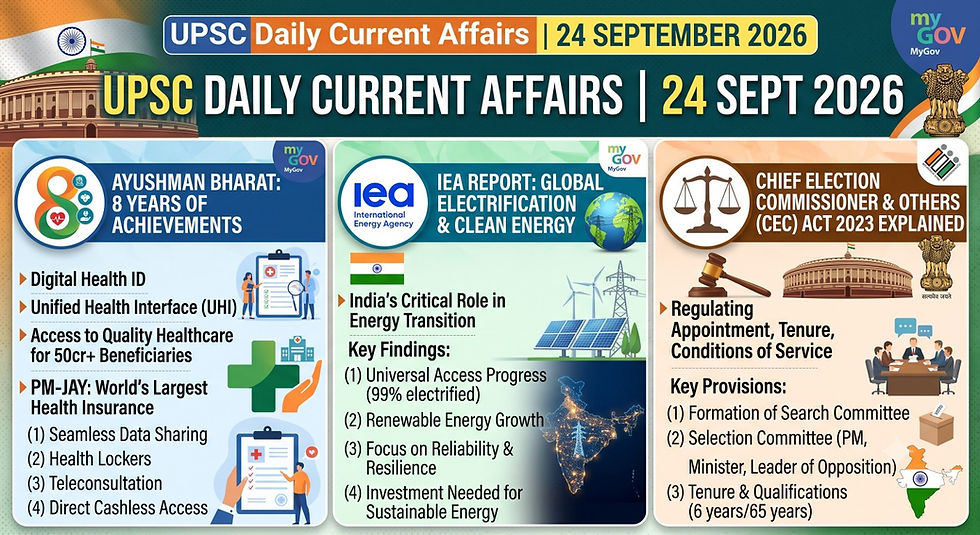
Today's current affairs cover eight subjects that matter for both Prelims and Mains: regionalism, health policy, energy transition, election law, trade remedies, public health, international security, ecology, and hydropower engineering. Skim the list below, then jump to any section that interests you.
GS2 (Polity): National Song case, CEC Act 2023, UP division debate
GS2 (IR): India-US trade talks, India-NZ FTA, US-Denmark-Greenland pact
GS3 (Economy): Anti-dumping duty, DDU-GKY budget
GS3 (Sci-Tech): Carbon fibre breakthrough
GS3 (Environment): Neelakurinji, biovigilance, SAWEN, rhinoceros
GS3 (Energy): IEA Electrification Report, Parbati Hydro Project
GS2 (Health): Ayushman Bharat, Hepatitis B and C
GS Paper 2 – Polity & Governance
1. Cannot Penalise Refusal to Sing National Song, Says SC
Supreme Court told the Centre this week that a person who skips singing Vande Mataram for religious reasons should not face criminal punishment. A three-judge bench led by Chief Justice Surya Kant was hearing a petition by Carnatic musician T.M. Krishna, who challenged the 2026 amendment to the Prevention of Insults to National Honour Act, 1971.
Amendment extended the same penal protection that covers the National Anthem to the National Song, making it punishable (up to three years in jail, a fine, or both) to intentionally stop someone from singing it or to disrupt an assembly singing it. Krishna argued that the last four stanzas of Vande Mataram invoke Hindu goddesses like Durga, Lakshmi and Saraswati, so forcing everyone to sing them clashes with India's secular character. The Court leaned on its 1986 Bijoe Emmanuel ruling, where it protected schoolchildren who stood respectfully but did not sing the national anthem due to their faith. Justice Bagchi said the same logic protects a "conscientious objector" here too.
Why it matters for UPSC: This links Article 25 (freedom of conscience) with Article 51A(a) (fundamental duties), a favourite GS2 essay theme.
2 CEC Act 2023 in News Appointment Process Explained
The Chief Election Commissioner and Other Election Commissioners Act, 2023 governs how India appoints its top election officials, and the Supreme Court is now deciding whether a bigger five-judge bench should examine challenges to it. The Act replaced a 1991 law and finally used the power under Article 324(2), which lets Parliament make rules for ECI appointments a power left unused for over 70 years.
Here is how the selection works in simple steps:
Step | Body | Composition | Role |
1 | Search Committee | Law Minister + 2 senior secretaries | Shortlists 5 names |
2 | Selection Committee | PM (Chair) + a Cabinet Minister + Leader of Opposition | Recommends final name to President |
Before this Act, the Supreme Court's 2023 Anoop Baranwal judgment had set up an interim panel that included the Chief Justice of India. The new law replaced the CJI with a Cabinet Minister nominated by the PM, a change petitioners say weakens the ECI's independence from the executive. A commissioner serves for six years or until age 65, whichever comes first, cannot be reappointed, and gets a salary equal to a Supreme Court judge.
3 Demand for Separate State: Article 3 & the UP Division Debate
A Uttar Pradesh cabinet minister reignited an old debate by suggesting the state could split into four parts once the ongoing caste census wraps up. This brings Article 3 of the Constitution back into focus: the provision that lets Parliament create new states or redraw boundaries.
Under Article 3, a bill to divide a state needs the President's prior recommendation, and the President must first ask the concerned state legislature for its opinion. But here's the key detail students often get wrong: the state legislature's view is only advisory. Parliament can go ahead even if the state assembly disagrees, and the bill only needs a simple majority to pass.
India has reorganised states before on these grounds:
Language: the States Reorganisation Act, 1956 created 14 states based on the Fazl Ali Commission report
Development neglect: Chhattisgarh, Jharkhand, and Uttarakhand were carved out in 2000
Political mobilisation: Telangana was created in 2014 after decades of agitation
Common triggers for such demands include uneven development (as with Vidarbha), resource-based resentment (Jharkhand's coal belt), and centralisation of power. A workable fix suggested by experts is reviving the Inter-State Council under Article 263, which has met only 11 times since 1990.
GS Paper 2: International Relations
1 India–US Trade Deal Unlikely Soon: What's Holding It Back?
A bilateral trade agreement between India and the United States remains stuck, with negotiators unable to close gaps on agriculture market access and tariff lines. Talks have dragged on for months without a breakthrough, and both sides continue exchanging proposals rather than finalising terms. For UPSC, track this as an example of how domestic political sensitivities (farm sector protection in India) can slow even friendly bilateral trade relationships.
2 India–New Zealand FTA to Come Into Effect in October
The India-New Zealand Free Trade Agreement, signed on 27 April 2026, will formally come into force on 20 October 2026, coinciding with Vijayadashami (Dussehra). New Zealand's Parliament passed the enabling law with strong bipartisan support (93 votes in favour, 26 against), clearing the last hurdle for ratification.
Key numbers to remember:
100% of India's exports to New Zealand become duty-free immediately
New Zealand will remove or cut tariffs on 95% of its exports to India
New Zealand commits USD 20 billion in investment into India over 15 years
Sectors that benefit most: textiles, leather, footwear, gems & jewellery, engineering goods
Sensitive Indian sectors like dairy, sugar, and edible oil stay outside tariff cuts
Prelims trap: Don't confuse the signing date (27 April 2026) with the entry-into-force date (20 October 2026) — UPSC loves testing this kind of date confusion.
3 US–Denmark–Greenland Security Pact: Why It Matters
The United States, Denmark, and Greenland signed a trilateral security agreement on the sidelines of the UN General Assembly, updating their 1951 defence pact. The deal expands US military access in Greenland, including new bases beyond the existing Pituffik Space Base without transferring sovereignty over the territory.
The pact also plans to link Greenland into America's missile-defence network, including the proposed "Golden Dome" shield, and gives the US, Denmark and Greenland joint veto power over foreign investment in sensitive infrastructure and critical minerals there. Greenland retains its right to self-determination, and any final agreement needs approval from both the Danish and Greenlandic parliaments. This matters strategically because it strengthens control over the Greenland-Iceland-UK Gap, a key route for submarines and emerging Arctic shipping lanes.
4 Pacific Island Nation in Focus: Internal Political Conflict
A Pacific island nation is going through internal political tension, drawing attention from regional observers who track stability in the Indo-Pacific. Such developments matter for India's Act East and Indo-Pacific outreach, since small island states are increasingly courted by major powers, including China, for strategic and maritime influence.
GS Paper 3: Economy
1 Anti-Dumping Duty (ADD) Explained with Recent Case
India recently extended the anti-dumping duty on 'Decor Paper' imported from China until 26 March 2027. Anti-dumping duty is a tax a country places on imported goods that are sold below their normal (home-market) price, to protect local industry from unfair competition.
Here's how the process works in India:
Domestic industry files a complaint with the Directorate General of Trade Remedies (DGTR)
DGTR investigates whether dumping happened, whether it caused injury, and whether the two are linked
It calculates the Dumping Margin and Injury Margin, and recommends the lower of the two (the Lesser Duty Rule)
The Department of Revenue under the Ministry of Finance formally notifies the duty
An ADD is legally grounded in Section 9A of the Customs Tariff Act, 1975, and internationally in Article VI of GATT 1994. It lasts five years by default and can be extended through a "sunset review" if dumping is likely to recur. Remember: ADD is different from Countervailing Duty (CVD), which counters government subsidies, not private pricing tricks.
2 Budget 2026-27: ₹750 Crore for DDU-GKY Rural Skilling
The Union Budget 2026-27 set aside ₹750 crore for the Deen Dayal Upadhyaya Grameen Kaushalya Yojana (DDU-GKY), a rural skilling scheme. Two special sub-programmes deserve attention:
Roshni: Targets youth in Left Wing Extremism (LWE)-affected districts, offers 40% reservation for women, and has now expanded to Aspirational Districts too.
Himayat: A dedicated skilling programme for Jammu & Kashmir and Ladakh, covering both rural and urban, BPL and APL youth, with 100% central funding through Mission Management Units.
Together, DDU-GKY 2.0 aims to connect rural youth with wage employment, self-employment, and gig-work opportunities.
GS Paper 3: Science & Technology
1 CSIR-NAL's Indigenous High-Strength Carbon Fibre Breakthrough
CSIR's National Aerospace Laboratories (CSIR-NAL) has unveiled machinery to produce high-strength carbon fibre domestically, reducing India's dependence on imports for advanced composite materials. Carbon fibre composites are lightweight yet extremely strong, making them essential for modern aircraft, satellites, and defence hardware. This development pushes India closer to self-reliance in a critical material where only a handful of countries currently hold manufacturing know-how.
GS Paper 3: Environment & Ecology
1 Neelakurinji: The Flower That Blooms Once in 12 Years
Neelakurinji is under threat again; unprotected hill ranges near Munnar, like Lakshmi Hills and Chinnakkanal, are seeing destruction of its blooms, worrying Kerala's Forest Department. Neelakurinji (Strobilanthes kunthiana) is a purplish-blue shrub found in the shola-grassland ecosystems of the Western Ghats, famous for turning entire hillsides blue once every 12 years before dying after seeding.
Quick facts:
Found mainly in Kerala (Munnar, Eravikulam), Tamil Nadu (Nilgiris, Palanis), and Karnataka (Kodagu, Chikkamagaluru)
The genus Strobilanthes has about 450 species worldwide; over 160 occur in India, with 72+ endemic to the Western Ghats
Kerala has a dedicated Kurinjimala Sanctuary to protect it
Protected under Schedule III of the Wildlife (Protection) Act, 1972
Its honey, called Kurinjithen, is prized for medicinal use
2 Biovigilance in India: Concept & Significance
The Government of India approved the Biovigilance Programme of India in September 2026 to track and prevent adverse reactions linked to medicines and biological products used in organ and tissue transplants. The Indian Pharmacopoeia Commission (IPC) leads this monitoring. It complements two existing systems, the Pharmacovigilance Programme of India (for drugs) and the Materiovigilance Programme of India (for medical devices), together forming a three-layer safety net for patients.
3 SAWEN: South Asia Wildlife Enforcement Network
SAWEN is a regional body of eight South Asian countries Afghanistan, Bangladesh, Bhutan, India, Maldives, Nepal, Pakistan, and Sri Lanka working together to fight illegal wildlife trade. Launched in 2011 in Paro, Bhutan, with its secretariat in Kathmandu, SAWEN recently adopted the "Kathmandu Declaration" at its first General Assembly, agreeing to treat wildlife crime as organised transnational crime linked to money laundering and corruption. The group also declared 30 January as "SAWEN Day" and adopted an Implementation Plan for 2026-2030.
4 Rhinoceros Conservation Update
India is home to the Greater One-Horned Rhinoceros (Rhinoceros unicornis), which has recovered from fewer than 200 individuals a century ago to roughly 4,000 today. About 80% of the world's population lives in India, mostly in Assam's Kaziranga National Park, with smaller groups in Manas, Pobitora, Orang, and Dudhwa (Uttar Pradesh) and Jaldapara (West Bengal). The species is listed as Vulnerable on the IUCN Red List (downgraded from Endangered in 2008) and enjoys the highest protection under Schedule I of the Wildlife (Protection) Act, 1972. Conservation tools like the Indian Rhino Vision 2020 programme and the RhODIS India DNA-forensics initiative have supported this recovery.
GS Paper 3: Energy & Infrastructure
1 IEA Electrification 2026 Report: Key Findings for India
The International Energy Agency released a Special Report on Electrification, prepared for Türkiye and Australia's COP31 presidency, showing that cost-effective electrification could raise electricity's share of global final energy use from about 23% today to 35% by 2035.
Key numbers:
Reaching this target needs annual electricity demand growth of around 1,400 TWh
Around half of oil-based road transport can already be electrified competitively; electric cars are roughly three times more energy-efficient than petrol vehicles
EVs already avoid 2.3 million barrels of oil demand a day — this could rise to 18 million barrels by 2035
About half of global space-heating demand and 40% of low- and medium-temperature industrial energy use can be electrified cost-effectively
Grids need to expand about 40% faster, and battery storage could grow nearly tenfold to 2,900 GW by 2035
Greater electrification could cut fuel import bills by roughly $400 billion a year by 2035
2 Parbati Hydroelectric Project: Delays & Himalayan Geology Challenges
The Himachal Pradesh Directorate of Energy ordered an inspection of the Parbati Hydroelectric Project-II after a sudden large water discharge from the dam in Kullu district. Built by NHPC, this 800 MW run-of-the-river project sits on the Parbati River, a tributary of the Beas, and uses a roughly 32-km-long Head Race Tunnel — one of India's longest — cut through fragile Himalayan rock.
The project has faced repeated setbacks: a tunnel fire, recurring water leaks, and testing incidents in both 2017 and September 2026, largely because the Pir Panjal range's crystalline rock is prone to squeezing and instability. Once fully operational, tailrace water flows into the downstream Parbati-III project, forming an integrated hydropower cascade supplying power to Himachal Pradesh, Punjab, Haryana, Delhi, Rajasthan, and UP.
GS Paper 2: Social Justice / Health
1 Ayushman Bharat at 8 Years: Coverage, Gaps & Digital Health Push
Ayushman Bharat completed eight years since its launch on 23 September 2018. It rests on four pillars: AB-PMJAY (cashless hospital insurance up to ₹5 lakh per family), Ayushman Arogya Mandirs (primary care centres), the Ayushman Bharat Digital Mission (digital health records), and PM-ABHIM (health infrastructure).
Scale achieved so far:
Over 485 million people (about 33% of India's population) hold verified Ayushman cards
More than 13.25 crore hospital admissions worth ₹2.03 lakh crore have been supported
Over 38,000 hospitals are empanelled, covering 1,961 procedures
97.61 crore ABHA digital health IDs created; 119.95 crore health records linked digitally
All senior citizens aged 70+ (about 6 crore people) got universal coverage from September 2024
Union Budget 2026-27 allocated ₹9,500 crore for AB-PMJAY. The biggest gaps remain: out-of-pocket spending on outpatient care and diagnostics isn't covered, private hospital participation in smaller towns is weak due to delayed claim settlements, and specialist shortages persist in rural primary centres.
2 Hepatitis B and C: Facts, Prevention & Government Response
India reaffirmed its commitment to eliminate Hepatitis B and C as public health threats by 2030, in line with UN Sustainable Development Goal 3.3, at a UN General Assembly side-event. Globally, about 304 million people live with chronic Hepatitis B or C, causing over 1.3 million deaths every year; together these two viruses cause roughly 80% of all liver cancers worldwide.
Feature | Hepatitis B | Hepatitis C |
Virus type | DNA virus (Hepadnaviridae) | RNA virus (Flaviviridae) |
Main spread | Birth, blood, unsafe injections, sexual contact | Mainly infected blood, shared needles |
Vaccine available | Yes | No |
Chronic progression | Persists via cccDNA reservoir | 70–80% of untreated cases turn chronic |
India runs the National Viral Hepatitis Control Programme (NVHCP), launched in 2018 under the National Health Mission, offering free, decentralised screening and treatment.
Miscellaneous / UPSC Prelims Bits
BRICS Young Tax Professionals Capacity Building Programme: First held in-person in India in April 2026, now institutionalised as an annual event to train young tax officials from BRICS nations.
SIMBEX 2026: The India-Singapore bilateral naval exercise, part of the ongoing calendar of Indian Navy joint drills with regional partners.
Kasturirangan Report: Continues to stay relevant in current-affairs quizzes for its recommendations on Western Ghats eco-sensitive zones — a useful static-dynamic link topic.
Interactive Section: Daily UPSC Prelims Quiz (5 MCQs)
Test yourself before moving to Mains practice. Try answering these without looking back:
Under the CEC Act 2023, who chairs the Search Committee?
What is the Lesser Duty Rule in anti-dumping cases?
Which Article of the Constitution governs state reorganisation?
How many countries are members of SAWEN?
By what year does the IEA target 35% global electrification?
(Answers: 1. Law Minister, 2. Applying the lower of the dumping margin or injury margin, 3. Article 3, 4. Eight, 5. 2035)
UPSC Mains Practice Corner
Practice question: "Regionalism in India is rooted in the interplay of identity, uneven development and competing claims over resources. Discuss its causes and manifestations. How does it affect national integration?" (GS1/GS2, 250 words)
Second question: "Universal Health Coverage in India remains a promise more on paper than in practice." Examine the institutional and fiscal constraints, and suggest measures to strengthen Ayushman Bharat implementation. (GS2, 250 words)
FAQs
What are UPSC Daily Current Affairs 24 September 2026?
The standout topics for UPSC Daily Current Affairs 24 September 2026 are the Ayushman Bharat 8th anniversary, the IEA Electrification 2026 report, the CEC Act 2023 Supreme Court case, and the India-New Zealand FTA's October 20 launch date.
Is Ayushman Bharat relevant for Prelims or Mains?
Both. Prelims asks about scheme features, pillars, and numbers (like the ₹5 lakh cover), while Mains asks analytical questions on healthcare financing gaps and Universal Health Coverage.
What is the CEC Act 2023?
It is the law that governs how India's Chief Election Commissioner and other Election Commissioners are appointed, following the Supreme Court's Anoop Baranwal judgment and using powers under Article 324(2).
What is the difference between anti-dumping duty and countervailing duty?
Anti-dumping duty counters unfairly low export pricing by a private company, while countervailing duty counters government subsidies given to exporters in the country of origin.
Why is the India-New Zealand FTA important for UPSC?
It tests both static polity/trade concepts (how FTAs work) and current dates (signing vs. entry-into-force), plus investment and market-access figures that often appear in Prelims MCQs.
What does the IEA Electrification 2026 report mean for India's climate goals?
It shows that transport, buildings, and industry can be electrified cost-effectively, supporting India's own push for EVs and renewable-linked grids while cutting fossil fuel import bills.
Is Neelakurinji a protected species under Indian law?
Yes, Strobilanthes kunthiana is protected under Schedule III of the Wildlife (Protection) Act, 1972, and illegal destruction of its blooms can attract fines or imprisonment.


Comments