Which NCERT Books to Read First for UPSC Preparation

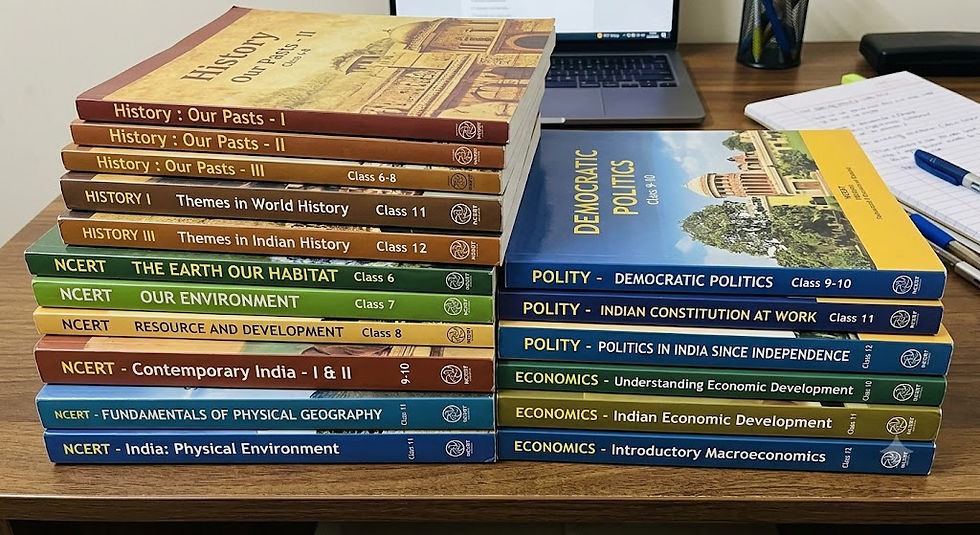
Start with the Class 6 to Class 10 History, Geography, and Polity NCERT books before moving to Class 11 and 12. These books are short, easy to understand, and build the base you need before you touch tougher reference books. Most UPSC toppers finish all major NCERT books in 60 to 90 days as their first step in preparation.
Why NCERT Books Matter for UPSC (Quick Answer Box)
NCERT books explain concepts in plain language, which makes them the best starting point for anyone new to UPSC. They cover the basic facts and ideas that bigger reference books assume you already know.
They build a strong foundation before you move to advanced books
UPSC often picks Prelims questions directly from NCERT content
Toppers quote NCERT lines in Mains answers for simple, clear explanations
They help you understand CSAT and Essay writing better too
They save time later because you won't need to relearn basics mid-preparation
Best NCERT Books Reading Order for UPSC (Step-by-Step)
Read NCERT books in the order they are taught in school, not randomly. This order helps because each class builds on the previous one, so skipping ahead creates gaps in understanding.
Step 1: Start with Class 6–8 NCERTs (History, Geography, Civics)
Begin here even if you studied these years ago. These books explain basic ideas like what a constitution is, how landforms are made, and how ancient civilisations began. Skipping this step often confuses later when Class 11 and 12 books use these terms without explaining them again.
Step 2: Move to Class 9–10 NCERTs
These books go a level deeper into History, Geography, Political Science (called Civics earlier), and introduce Economics. Class 9 and 10 Political Science books are especially useful because they explain the Indian Constitution in simple terms.
Step 3: Read Class 11–12 NCERTs (core/advanced)
These are the most detailed and exam-relevant books. Class 11 and 12 History, Geography, Polity, and Economics NCERTs cover topics that appear often in both Prelims and Mains. Give these books the most time and attention.
Step 4: Optional/Skip list (which ones to deprioritize)
Not every NCERT book carries equal weight for UPSC. Some can be read quickly, and a few can be skipped altogether (covered in detail later in this article).
Subject-Wise NCERT Book List for UPSC
Different subjects need different levels of attention. Use this table as a quick reference while planning your NCERT reading.
History NCERT Books for UPSC
Class | Book Name | Focus Area | Priority |
6 | Our Pasts I | Ancient India | High |
7 | Our Pasts II | Medieval India | High |
8 | Our Pasts III | Modern India (early) | High |
9 | India and the Contemporary World I | World History basics | Medium |
10 | India and the Contemporary World II | Nationalism, Freedom struggle | High |
11 | Themes in World History | World events | Medium |
12 | Themes in Indian History I, II, III | Ancient to Modern India in depth | High |
Geography NCERT Books for UPSC
Class | Book Name | Focus Area | Priority |
6 | The Earth Our Habitat | Basic Geography terms | High |
7 | Our Environment | Climate, natural vegetation | High |
8 | Resource and Development | Resources, agriculture | High |
9 | Contemporary India I | Physical features of India | High |
10 | Contemporary India II | Resources and development in India | High |
11 | Fundamentals of Physical Geography | Landforms, climate systems | High |
11 | India: Physical Environment | India's physical geography | High |
12 | Fundamentals of Human Geography | Population, settlements | High |
12 | India: People and Economy | India's human geography | High |
Polity/Civics NCERT Books for UPSC
Class | Book Name | Focus Area | Priority |
9 | Democratic Politics I | Basics of democracy | High |
10 | Democratic Politics II | Political parties, outcomes of democracy | High |
11 | Indian Constitution at Work | Constitution in detail | High |
12 | Politics in India Since Independence | Post-independence political history | High |
Economics NCERT Books for UPSC
Class | Book Name | Focus Area | Priority |
9 | Economics | Basic economic concepts | Medium |
10 | Understanding Economic Development | Development, sectors of economy | High |
11 | Indian Economic Development | Indian economy in detail | High |
12 | Introductory Microeconomics | Theory-heavy, less exam relevant | Low |
12 | Introductory Macroeconomics | National income, money, banking | Medium |
Science NCERT Books for UPSC Prelims
Full Science NCERT books are not needed. Read selected chapters from Class 6 to 10 Science books, focusing on topics like nutrition, diseases, environment, and basic physics concepts that often appear in Prelims General Science questions.
Which NCERT Books Beginners Should Read First (Priority List)
If you are just starting, do not try to read everything at once. Focus on these five books first, since they give the biggest return on your time.
Class 9 & 10 Democratic Politics I & II – Takes about 7 days; builds your Polity base
Class 10 Contemporary India II (Geography) – Takes about 5 days; covers Indian resources clearly
Class 10 India and the Contemporary World II (History) – Takes about 6 days; covers the freedom struggle
Class 11 Indian Economic Development – Takes about 8 days; explains the Indian economy in a simple way
Class 12 Fundamentals of Human Geography – Takes about 6 days; connects population and development topics
Starting with these five books gives you working knowledge across all four major subjects within a month.
NCERT Books to Skip or Skim for UPSC
Some NCERT books repeat content you will already know, and a few contain topics outside the UPSC syllabus. Reading these carefully wastes valuable time.
Class 12 Introductory Microeconomics – Too theory-heavy and rarely tested directly
Class 6–8 Economics chapters (where included in EVS or Social Science) – Very basic, already covered better in Class 9–10 books
Chapters on local or regional history in Class 6–8 History books that don't connect to the national syllabus
Old editions with outdated data – Always check for the latest edition, especially for Geography and Economics books, since population and economic figures change
Skim these sections instead of reading word by word. A quick read is enough to know they exist.
How to Read NCERT Books Effectively for UPSC (Not Just What)
Reading NCERT books once is not enough. You need a method that helps you remember and connect what you read.
Make short notes after every chapter in your own words, not by copying lines
Link topics to current affairs — for example, connect the Geography chapter on rivers to a recent news story about a river dispute
Practice with maps while reading Geography chapters; draw outlines and mark locations yourself
Highlight only key terms, not full paragraphs, so your notes stay useful for quick revision
Read one subject at a time instead of jumping between History, Geography, and Polity in the same day
This method takes slightly longer at first but saves much more time during revision.
NCERT Books vs Standard Reference Books — When to Switch
NCERT books give you the base, but they don't go deep enough for every topic UPSC asks about. Standard reference books add detail, analysis, and updated information that NCERT books don't cover.
When NCERT is enough:
Building your first understanding of a topic
Preparing for basic factual questions in Prelims
Understanding how a subject connects across classes
When to move to reference books:
Polity: Move to Laxmikanth's Indian Polity after finishing NCERT Polity books
History: Move to Spectrum's A Brief History of Modern India after Class 10 and 12 History NCERTs
Geography: Move to G.C. Leong's Certificate Physical and Human Geography for deeper physical geography concepts
Economy: Follow current affairs and a basic economic survey summary after finishing NCERT Economics
Think of NCERT books as the foundation of a house and reference books as the walls built on top. You cannot skip the foundation and expect the walls to stay strong.
Where to Download NCERT Books for UPSC Preparation (Free & Legal)
NCERT provides all its textbooks free of cost on its official website, ncert.nic.in. You can download PDF versions for every subject and class without paying anything.
Visit the official NCERT website and go to the "Publications" or "e-books" section
Select your class and subject to find the correct PDF
Organise downloaded PDFs into folders by subject and class for easy access later
Avoid third-party websites that may host outdated or incorrect versions of the books
Downloading directly from the official site also ensures you get the latest edition, which matters most for Geography and Economics.
NCERT Books for UPSC in Hindi Medium
NCERT books are available in Hindi for every subject and class, so Hindi medium candidates don't lose out on quality content. The Hindi versions are direct translations, so the information matches the English editions exactly.
Download Hindi medium PDFs from the same official NCERT website
Hindi medium candidates should still learn key terms in English, since many current affairs sources and answer-writing formats use English terms
Keep a small glossary of English terms alongside your Hindi notes for terms like “federalism,” “fiscal deficit,” or “biodiversity”
This small habit makes it easier to switch between Hindi study material and English news sources during preparation.
Sample NCERT Reading Timeline (30/60/90 Day Plan)
Use this timeline as a guide to track your progress. Adjust the pace based on how much time you can give each day.
Days | Subject Focus | Books to Cover | Target |
1–15 | Polity | Class 9, 10, 11 Political Science | Finish all three books |
16–30 | History | Class 9, 10, 12 History books | Finish the freedom struggle and modern India |
31–45 | Geography | Class 9, 10 Geography, Class 11 Physical Geography | Finish Indian and physical geography |
46–60 | Geography (continued) | Class 11 India: Physical Environment, Class 12 books | Complete human geography |
61–75 | Economics | Class 10, 11 Economics | Finish Indian economic development |
76–90 | Revision + Science | Revise weak areas, read Science chapters | Complete first full NCERT cycle |
By day 90, you should have read every high-priority NCERT book at least once and made notes for revision.
Frequently Asked Questions
Which NCERT book should I read first for UPSC? Start with the Class 9 and 10 Political Science books (Democratic Politics I and II). They are short, simple, and explain the basics of the Indian Constitution clearly.
How many NCERT books are required for UPSC? Around 15 to 18 NCERT books across History, Geography, Polity, and Economics from Class 6 to 12 are commonly recommended. Not all chapters in every book need equal attention.
Is NCERT enough for UPSC prelims? NCERT builds your foundation but is not enough on its own. You still need current affairs, standard reference books, and practice with previous year question papers.
Can I skip Class 6–8 NCERT books? You can skim them if you already have a strong basic understanding, but don't skip them completely if you are a beginner, since they introduce terms used in higher classes.
How long does it take to finish all NCERT books for UPSC? Most aspirants take 60 to 90 days to complete all major NCERT books while also making notes, based on 3 to 4 hours of daily reading.
Key Points
Start with Class 9 and 10 Polity and Geography NCERTs before moving to Class 11 and 12
Follow the class-wise order instead of jumping between books randomly
Skip or skim low-priority books like Class 12 Microeconomics to save time
Make notes in your own words and link topics to current affairs while reading
Move to standard reference books like Laxmikanth and Spectrum only after finishing NCERT
Download NCERT books free from the official NCERT website in both English and Hindi
Follow a 90-day timeline to complete your first full NCERT reading cycle
Conclusion
NCERT books are not a formality in UPSC preparation - they are the actual starting point that decides how easily you understand everything that comes after. Reading them in the right order, spending more time on high-priority books, and skipping the parts that don't matter can save you weeks of confusion later. Once you finish this first NCERT cycle, moving to advanced reference books and current affairs will feel far more manageable.


Comments